
Herion addicts like heroin... Just like we like our phones...
Educational Content Disclaimer: This article provides educational information only and is not intended as medical advice, diagnosis, or treatment. The content discusses general health topics and should not replace consultation with your licensed healthcare provider. Always consult with your doctor before making changes to your diet, supplements, or medications. Dr. JJ Gregor is a Doctor of Chiropractic licensed in Texas and practices within the scope of chiropractic care.
Every generation thinks it's the worst. We are, as a species, constitutionally Chicken Little. The sky is always falling.
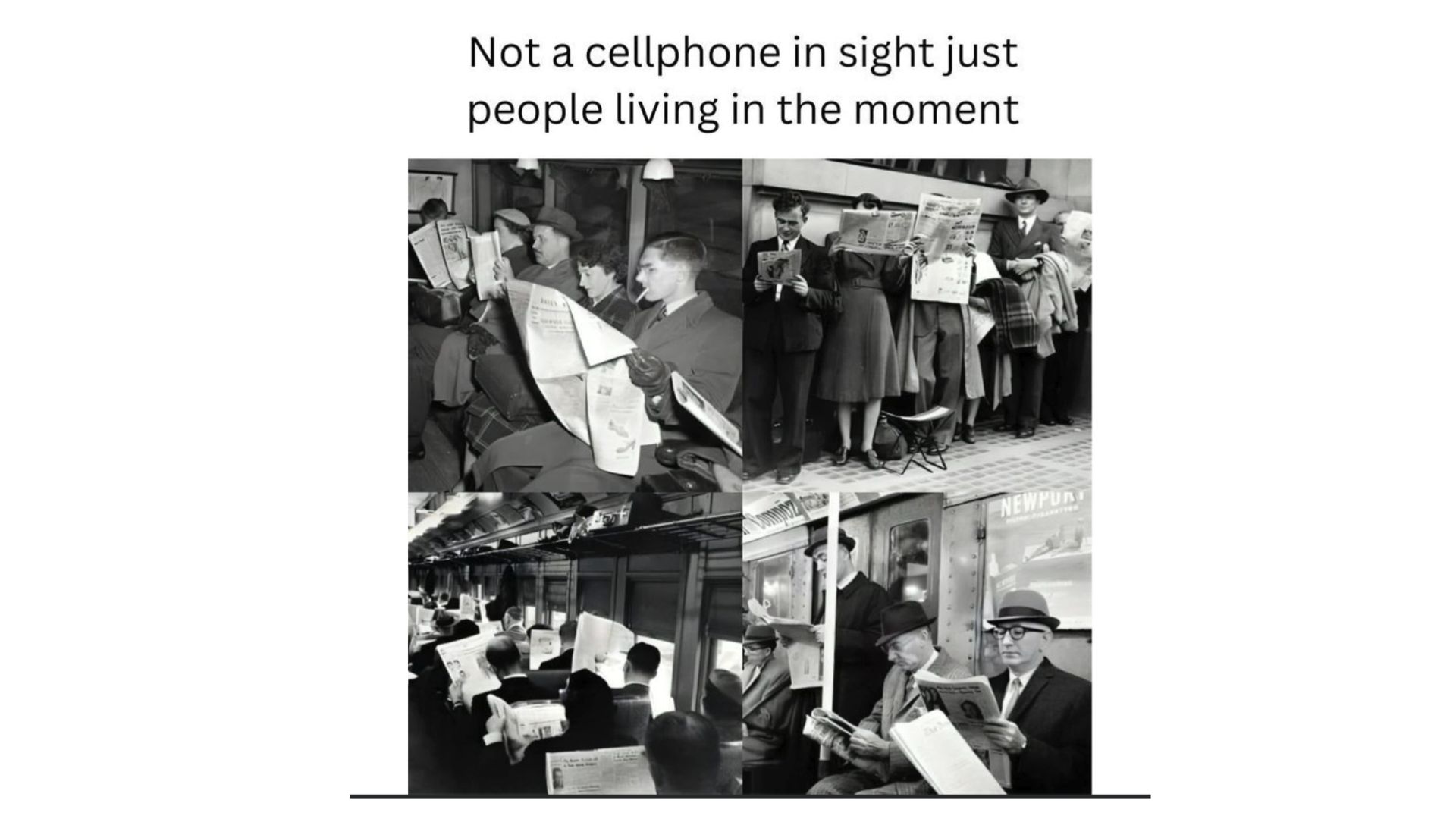
The meme at the top of this post makes that point better than I can. We look at people glued to their phones and declare the death of real human connection. And then you see the photo below it: a train car full of people in their Sunday best, every single face buried in a newspaper. Not one of them talking to each other. Not one of them present.
Socrates (or Plato, one of the two) reportedly said that writing things down would be the death of intellectualism, because no one would have to remember anything anymore. Every generation gets its version of this panic. Every generation is certain theirs is the one that finally broke humanity.
So let's take the moral superiority out of this conversation before we go any further.
The newspaper thing, though. There is actually a difference worth naming. Once you read the article, you were done with it. Maybe you cut it out and saved it. I remember doing that as a kid, cutting out the football articles in case our team got mentioned, putting them in a scrapbook. There was an end to it. A natural stopping point. You finished the paper and you put it down.
We don't have that anymore. We have consume, consume, consume. More, more, more. Faster, faster, faster. The feed never ends because it was designed to never end.
And here is what is actually different today, the thing that does not have a historical equivalent: it is a chemical addiction. Not a habit. Not a tendency. A chemical dependency that looks, on a brain scan, almost identical to heroin withdrawal.
That is not a metaphor. That is a finding from a peer-reviewed fMRI study published last year. Three days without your phone produces brain activity nearly identical to three days without heroin for an addict.
The good news is buried in that same finding. Unlike heroin, there is not a significant chemical substrate that has to be physically cleared. The brain starts to rewire itself pretty effectively once the signal stops. The recalibration begins within that same 72-hour window.
But first you have to understand why stopping is so hard. Because if you think this is a willpower problem, you will fail. Every time.
I'll be honest about where I found this research. Dave Asprey posted it on social media. I understand the irony of that is not lost on anyone, including me. I have a long and complicated relationship with Asprey. I think he's brilliant. I think he overstates a lot of cases. I've spent years trying to prove him wrong and keep failing to do it completely. When he flags something, I pay attention, even when I find it on the exact platform I'm about to tell you is wrecking your nervous system.
I'll also be honest about why I'm writing this now specifically. Last year I got genuinely twisted up about a lot of what was happening in the world. The news cycle. The political noise. The constant low-grade activation of it. I think it was bad for my health going into this year. That's not an abstraction. That's a clinical observation I'm making about myself.
This post exists because of that.
I recently took a group of 14-year-olds to play airsoft.
Outdoor physical activity. Real environment. Running around shooting at each other, which sounds exactly like what a teenager should be doing on a Saturday. And somewhere in the middle of it, I heard one of them say they couldn't wait until next year when they'd be old enough to get Instagram.
They were jonesing for an app they don't even have yet.
Not for something they'd experienced and missed. For something they'd been conditioned to anticipate through years of watching everyone around them use it. The craving was already installed before they ever had access to the product.
That's when it hit me how deep this actually goes.
Here's the mechanism.
Every time you pick up your phone and something rewarding happens, your brain releases dopamine. That's the signal that something worth paying attention to just occurred. Your brain does not stay calibrated to that level of dopamine indefinitely. It adjusts. It downregulates the receptors that receive the signal, so the same input produces less response over time. This is called receptor downregulation, and it is not unique to smartphones. It is the exact same process that occurs with cocaine, alcohol, and prescription opioids.
The dose that worked last week does not work this week.
So the content gets shorter, louder, more extreme, more provocative. Not because the platforms have bad taste. Because they employ extraordinarily sophisticated behavioral scientists running real-time optimization on what keeps your dopamine system activated. They are not guessing. They are running experiments on you, continuously, and adjusting the output based on your response.
This is not a cautionary tale about unintended consequences. This is not a technology company that meant well and accidentally created addiction. Purdue Pharma did not accidentally create OxyContin dependency. McKinsey wrote the strategy documents. The consultants were in the room. The business model required the addiction, so they engineered it, and then hired lobbyists to manage the fallout when the bodies started piling up.
The attention economy is the same playbook. Different product. Same architecture.
The variable reward schedule is the key mechanism. A slot machine does not pay out on a predictable interval. It pays out randomly, just often enough to keep you pulling the lever. Your news feed is a slot machine. Your social media is a slot machine. The outrage cycle is a slot machine. Random intermittent reward is the most powerful behavioral conditioning mechanism ever identified in the psychological literature, and it is the foundational architecture of every major social media platform.
This is not an accident and it is not a byproduct. It is the design.
If you've read anything I've written about hyperpalatable food, you already understand this pattern. The mass food industry spent decades and billions of dollars engineering products that hijack your satiety signals. The exact right combination of salt, fat, and sugar to override the biological mechanisms that would otherwise tell you to stop eating. Your body isn't broken. It's responding exactly as designed to stimuli that were engineered to overwhelm it. The result is metabolic dysfunction at a population level, and the people who built the product knew what they were building.
Your phone is doing the same thing to your reward system that processed food did to your metabolic system. Engineered overconsumption. Engineered dependency. Engineered craving that persists even when you're not using it.
That last part is important.
The craving does not require the phone to be present.
A 2024 study on what researchers call desire thinking found that the mechanism amplifying craving is not just seeing the device. It's mentally rehearsing using it. Your brain starts running the simulation: what might be there, who might have responded, what might have happened since you last checked. That mental rehearsal amplifies craving the same way physical cue exposure does. Which is why people in their own homes, phone in another room, still feel the pull. The trigger is not just the device. It's the habit of mental rehearsal that the device has trained into you.
Those 14-year-olds running around in the woods weren't just bored. They were running that simulation. They'd been conditioned to run it before they ever had the product.
There is also something happening in your prefrontal cortex that I want to be specific about, because this is where it stops being an inconvenience and starts being a clinical problem.
The prefrontal cortex handles your capacity for sustained attention, inhibitory control, planning, decision-making, and cognitive flexibility, which is your ability to shift between mental states rather than getting locked into habitual patterns. A 2017 EEG study found that heavy smartphone users show reduced right prefrontal cortex excitability and measurable impairment in attention and processing. A 2023 fMRI study found that the frontoparietal network, which coordinates executive attention and cognitive control, shows aberrant function in excessive smartphone users across every cognitive task tested. Not just phone-related tasks.
Every task.
The impairment is not situational. It is systemic.
A 2020 study that actually measured neurotransmitter concentrations in addicted teenagers using MRS spectroscopy found elevated GABA in the anterior cingulate cortex. The anterior cingulate cortex is your conflict monitoring system. It's the region that detects when you're doing something that conflicts with your goals and signals that more executive control is needed. When GABA is elevated in that region, it's being inhibited. The brain has chemically suppressed its own conflict detector.
This is the neuroscience of why "just stop" doesn't work as an instruction.
The region that would generate the awareness that you need to stop has been pharmacologically quieted. Not by an external substance. By your brain's own inhibitory system, adapting to the pattern of use you have established. The same study found that nine weeks of cognitive behavioral therapy moved those GABA levels back toward normal. The change is reversible. But it requires more than an intention.
Most conversations about smartphone addiction stop at the personal health level. I want to go one level higher, because that's where the real stakes are.
A 2025 neuroimaging meta-analysis compared the brain activity of smartphone addicts and substance addicts during cue exposure and found the shared substrate: the nucleus accumbens and the anterior cingulate cortex activate in both populations when exposed to addiction-relevant cues. Same circuits. Same mechanism. Different substance. And a team of academic moral philosophers at Cambridge University, publishing in peer-reviewed literature with over 200 citations, concluded that social media companies deliberately design their platforms to produce this state, that doing so is ethically impermissible because it harms users and is exploitative, and that the attention economy business model strongly incentivizes the wrongdoing.
That is not a blogger's opinion. That is Cambridge moral philosophy on record.
The Epstein files are real. The congressional hush money slush fund, the one that paid out sexual harassment settlements with taxpayer money and then sealed the list of names, is real. The government's own admission of its role in Lyme disease research is real. Iran. Energy prices structured by policy rather than scarcity. The pattern in which official statements reverse themselves the moment documentation surfaces.
The outrage is warranted. The information is real. The problem is what happens to that information inside a nervous system that has been kept in a state of low-grade dopamine withdrawal, elevated cortisol, and suppressed prefrontal executive function.
You can be fully informed, genuinely activated, and completely incapable of doing anything consequential. That is not an accident. That is the architecture. Informed. Activated. Exhausted. Passive. The establishment does not need to censor anything. They just need you consuming real information on a device that has compromised the neural infrastructure required to act on it.
Your anger is the product. They are selling your cortisol-flooded, dopamine-depleted attention to advertisers.
You are not the customer. You are what is being sold.
I am a people-first constitutional libertarian. I believe individual sovereignty is the only durable answer to institutional capture. The people who wrote the Constitution had lived through concentrated power. They understood viscerally what it does. They designed a system that only works if the citizenry is capable of actually governing itself.
You cannot be that citizenry on a receptor-downregulated brain.
You cannot hold anyone accountable if you cannot sustain attention long enough to read the actual legislation. You cannot build real local community if your social circuitry is being redirected into a screen. You cannot repair your own things, your health, your relationships, your local institutions, when you are too cognitively depleted to learn anything that takes longer than 60 seconds to explain. The right to repair is not just about your appliances. It is about refusing engineered dependency as a permanent condition of modern life.
This is, at its foundation, a spiritual fight.
Whatever language you use for it: God versus evil, light versus darkness, sovereignty versus managed livestock. The question is whether your attention, your cognition, your capacity for self-determination, and your ability to recognize what is being done to you belong to you, or to the entities that have spent billions of dollars engineering your dependency on them. That framing sounds dramatic until you look at the brain scans. Then it sounds like a clinical description of what's happening.
Here is what the research says about reversing it.
The 72-hour window is real. Participants in the restriction study reported measurably better mood and quality of life within three days. The companion fMRI study showed resting-state neural activity beginning to reorganize during that same window. The receptor downregulation that makes real life feel flat and insufficient compared to a screen starts reversing within three days.
But reversing it is not a willpower exercise. Willpower fails because it requires the very prefrontal executive resources that the addiction has depleted. You cannot fight your neurochemistry with the system the neurochemistry has already compromised.
The research points toward structural interventions: removing cues before craving starts, changing the environment rather than relying on inhibitory control, and specific physical activities that accelerate neurological recalibration. A 2020 review of exercise interventions for internet addiction found that exercise works through three specific mechanisms: HPA axis normalization, restoration of brain-derived neurotrophic factor which supports prefrontal cortex structure, and dopamine receptor upregulation, which is the direct reversal of the downregulation that drove the addiction. A 2026 EEG study confirmed that acute aerobic exercise normalized brain electrical patterns and improved cognitive performance in smartphone-addicted adolescents.
Exercise during a phone detox is not a wellness add-on. It is targeted neurological rehabilitation.
Start here before Tuesday. Tonight, charge your phone outside your bedroom. Physical alarm clock. No exceptions. That one environmental change removes the first thing your brain reaches for in the first 30 seconds of consciousness, which is when the desire thinking loop starts. It costs you nothing and it breaks the cue before the craving has anywhere to go.
Tuesday I'm publishing the full framework. The actual protocol, hour by hour, with the physiological rationale for each intervention. Not screen time limits and a suggestion to drink more water. The real architecture of how you recalibrate a hijacked reward system.
Your brain is worth the three days.
Dr. JJ Gregor is a chiropractic physician specializing in Applied Kinesiology and functional neurology in Frisco, Texas. If your nervous system has not had a real break in longer than you can remember, that is worth a conversation. Schedule a consultation.
Stay connected with news and updates!
Join our mailing list to receive the latest news and updates from our team.
Don't worry, your information will not be shared.