
The Circadian Reset Protocol: How to Actually Fix What Daylight Saving Time Broke

Educational Content Disclaimer: This article provides educational information only and is not intended as medical advice, diagnosis, or treatment. The content discusses general health topics and should not replace consultation with your licensed healthcare provider. Always consult with your doctor before making changes to your diet, supplements, or medications. Dr. JJ Gregor is a Doctor of Chiropractic licensed in Texas and practices within the scope of chiropractic care.
If you're reading this, you survived Monday. Which is apparently one of the least healthy and most dangerous days on the calendar, so good job.
If you haven't read Part 1 yet, go back and do that first. The short version is: this isn't just one bad Monday. It's a population-wide circadian disruption with measurable consequences, and it takes four to five weeks to fully recover from. If you're lucky, you'll start feeling normal again by this weekend. But don't count on it.
And I'm sorry, I still don't care if yo...
Daylight Saving Time Is a Public Health Crisis (And We Do It On Purpose)
Educational Content Disclaimer: This article provides educational information only and is not intended as medical advice, diagnosis, or treatment. The content discusses general health topics and should not replace consultation with your licensed healthcare provider. Always consult with your doctor before making changes to your diet, supplements, or medications. Dr. JJ Gregor is a Doctor of Chiropractic licensed in Texas and practices within the scope of chiropractic care.
Welcome to my absolute least favorite day of the year.
Last night, an hour was stolen from most of America. We don't get it back until we return to standard time in the fall. This morning, millions of people dragged themselves out of bed feeling like garbage. Tomorrow morning is going to be worse, because the acute hit of the clock change compounds when the work week starts and the alarm goes off earlier than your biology is ready for.
It's asinine. I hate it. I've hated it for years, and the data keeps giving ...
What Getting Present Actually Does to Your Body

Educational Content Disclaimer: This article provides educational information only and is not intended as medical advice, diagnosis, or treatment. The content discusses general health topics and should not replace consultation with your licensed healthcare provider. Always consult with your doctor before making changes to your diet, supplements, or medications. Dr. JJ Gregor is a Doctor of Chiropractic licensed in Texas and practices within the scope of chiropractic care.
So what the hell does it really mean for your health when the angry dictator of your thoughts (the guy with the German accent and the shitty little mustache, you know the one), that petulant little toddler of a hypercritical internal dialogue, rears his ugly little attitude?
One post wasn't enough. Learning why something works helps you figure out how to unplug it and unwind it.
In the last post we talked about the default mode network: the internal dialogue running old programming, generating anxiety about thi...
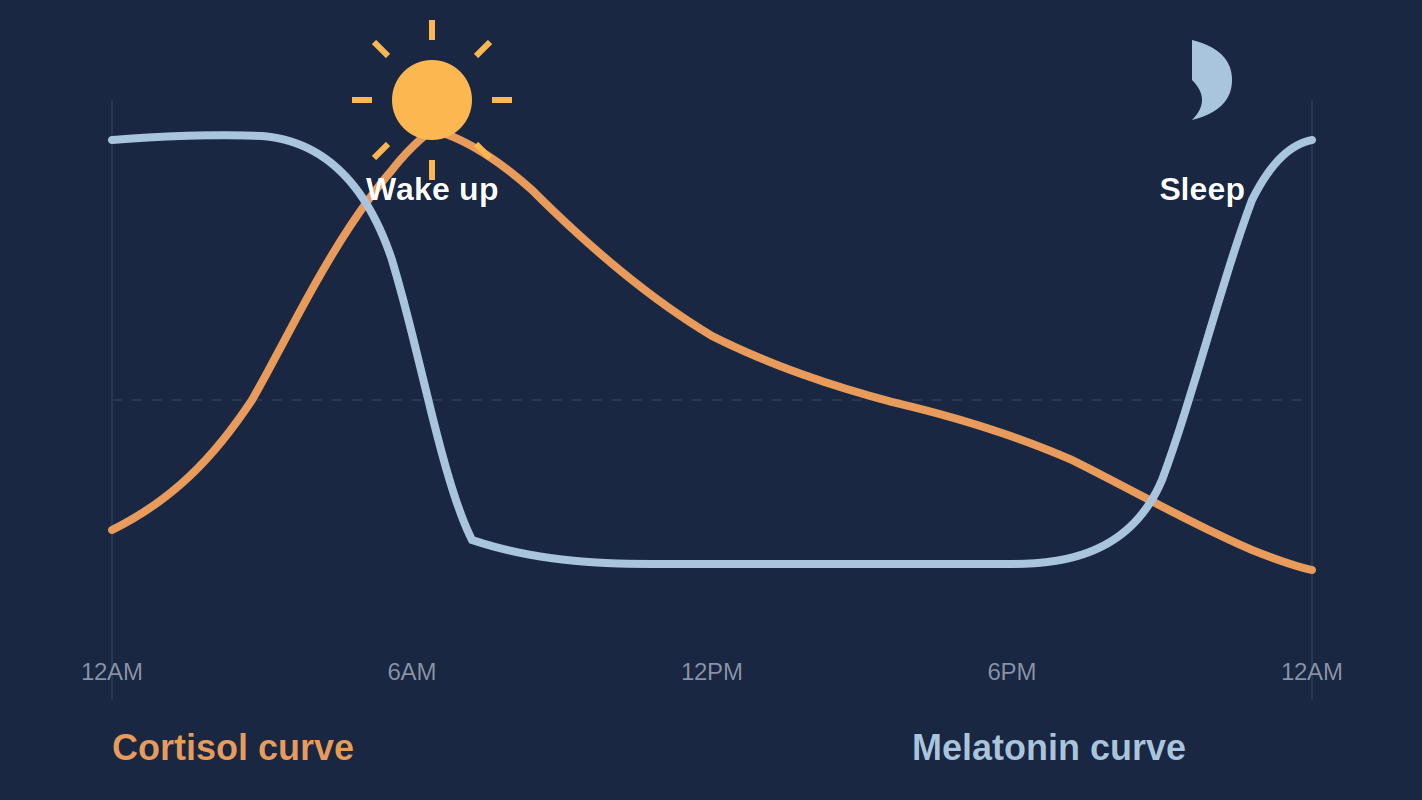
Why You Can't Sleep at Night But Can't Wake Up in the Morning (The Cortisol Problem)
Educational Content Disclaimer: This article provides educational information only and is not intended as medical advice, diagnosis, or treatment. The content discusses general health topics and should not replace consultation with your licensed healthcare provider. Always consult with your doctor before making changes to your diet, supplements, or medications. Dr. JJ Gregor is a Doctor of Chiropractic licensed in Texas and practices within the scope of chiropractic care.
You can't fall asleep at night. Your mind won't shut off. You're exhausted but wired. When you finally do sleep, you wake up at 2 or 3 AM and can't get back to sleep.
Then morning comes. The alarm goes off. You feel like you've been hit by a truck. You can't get out of bed. Coffee doesn't help. You're a zombie until 10 or 11 AM.
This sounds like two separate problems. It's not.
It's one problem: your cortisol rhythm is broken.
What Cortisol Is Supposed To Do
Cortisol is your primary stress hormone, produced...
Why Everyone's Adrenals Are Getting Destroyed Right Now (And What To Do About It)

Educational Content Disclaimer: This article provides educational information only and is not intended as medical advice, diagnosis, or treatment. The content discusses general health topics and should not replace consultation with your licensed healthcare provider. Always consult with your doctor before making changes to your diet, supplements, or medications. Dr. JJ Gregor is a Doctor of Chiropractic licensed in Texas and practices within the scope of chiropractic care.
Everyone is stressed as hell right now and they're getting their ass kicked.
Every person. Every appointment. Every conversation.
Anxiety. Stress. Fear. Sitting in the chest. Crushing. I wrote most of this after teaching at ICAK's winter meeting in Orlando. What became clear in the days after confirmed what I was already seeing in the clinic: everyone, and I do mean everyone, is getting crushed by adrenal exhaustion right now.
Almost all of my patients this week said some version of "I don't know what's wrong ...
The Best Way To Control Your Holiday Stress

Educational Content Disclaimer: This article provides educational information only and is not intended as medical advice, diagnosis, or treatment. The content discusses general health topics and should not replace consultation with your licensed healthcare provider. Always consult with your doctor before making changes to your diet, supplements, or medications. Dr. JJ Gregor is a Doctor of Chiropractic licensed in Texas and practices within the scope of chiropractic care.
The holidays bring unavoidable stress. Family gatherings. Shopping. Travel. Financial pressure.
You can't eliminate those stressors. But you can stop amplifying them.
The biggest amplifier? Blood sugar chaos.
Here's what most people miss: your adrenal glands can't tell the difference between a blood sugar crash and an emotional crisis. Both trigger the same cortisol release. Both deplete your stress reserves.
During the holidays, you're already maxed out managing unavoidable stressors. Why add fuel to the fir...
What is Adrenal Fatigue?

What is Adrenal Fatigue?
Adrenal fatigue is one of those terms that natural health practitioners have discussed for decades, but conventional medicine is only recently beginning to acknowledge.
You won't find "adrenal fatigue" in medical textbooks. It's not recognized as a disease. But the symptoms are real, the mechanism is understood, and millions of people are suffering from it right now.
Adrenal fatigue describes a state where your adrenal glands can't keep up with the demands placed on them. They're not pathologically diseased (Addison's disease). They're just exhausted—hypofunction rather than complete failure.
This matters because your adrenal glands regulate stress response, inflammation, blood sugar, immune function, energy production, and more. When they're depleted, everything breaks down.
Here's what adrenal fatigue actually is, how to recognize it, and what to do about it.
Understanding Your Adrenal Glands
Your adrenal glands sit on top of your kidneys. They're smal...
How Often Can You Go to CrossFit or HIIT Exercises

Educational Content Disclaimer: This article provides educational information only and is not intended as medical advice, diagnosis, or treatment. The content discusses general health topics and should not replace consultation with your licensed healthcare provider. Always consult with your doctor before starting any new exercise program. Dr. JJ Gregor is a Doctor of Chiropractic licensed in Texas and practices within the scope of chiropractic care.
The Sprint That Fed the Tribe
Your ancestors tracked game for hours—sometimes days—at a conversational pace. Low heart rate. Fat-burning metabolism. Sustainable forever.
Then came the moment: The final chase. The spear throw. The takedown.
Thirty to ninety seconds of maximum effort. Complete glycogen depletion. Explosive power. Then it was over.
That brief, intense burst—the kill—happened once or twice a week when the hunt was successful. The rest was walking, tracking, and carrying meat back to camp.
High-intensity interval train...
The Science Behind the Adrenal Gland
The Science Behind the Adrenal Gland
Your adrenal glands are walnut-sized organs that sit on top of your kidneys. They're small, but they control nearly every aspect of your stress response, energy production, immune function, and metabolic health.
When your adrenals function properly, you handle stress efficiently. When they're exhausted, everything breaks down—fatigue, inflammation, hormone imbalances, blood sugar crashes, immune dysfunction.
Understanding how your adrenal glands work helps you recognize when they're failing and what to do about it.
Here's the science behind adrenal function, the three major stress hormones, and why chronic stress wrecks your health.
The Three Major Adrenal Hormones
Your adrenal glands produce dozens of hormones, but three dominate your stress response:
1. Epinephrine (Adrenaline)
Epinephrine is your immediate "fight or flight" hormone.
Example: You're driving. The car in front of you slams on its brakes. You swerve into the next lane, barel...
You Might Be More Stressed Than You Think
You Might Be More Stressed Than You Think
Do any of these sound familiar?
Low energy and chronic fatigue. Dizziness when you stand up quickly. Asthma and allergies. Sunlight sensitivity (bright lights hurt your eyes, you constantly wear sunglasses). Muscle and joint pain. Anxiety, panic attacks, and blood sugar crashes. Insomnia. Low sex drive. Digestive issues. Heart palpitations. Thyroid problems.
These symptoms seem random and unconnected.
They're not.
There's one common link: stress and adrenal dysfunction.
Here's why stress affects every system in your body, how to recognize when you've exceeded your adaptive capacity, and what to do about it.
The Problem With How Medicine Views Stress
Most conventional doctors don't recognize the gray zone between "healthy" and "diseased."
In orthodox medicine, you're either pathologically sick (Addison's disease, Cushing's syndrome) or you're fine. There's no middle ground.
But pathology doesn't appear overnight. You don't wake up one ...