
Why You Can't Sleep at Night But Can't Wake Up in the Morning (The Cortisol Problem)
Educational Content Disclaimer: This article provides educational information only and is not intended as medical advice, diagnosis, or treatment. The content discusses general health topics and should not replace consultation with your licensed healthcare provider. Always consult with your doctor before making changes to your diet, supplements, or medications. Dr. JJ Gregor is a Doctor of Chiropractic licensed in Texas and practices within the scope of chiropractic care.
You can't fall asleep at night. Your mind won't shut off. You're exhausted but wired. When you finally do sleep, you wake up at 2 or 3 AM and can't get back to sleep.
Then morning comes. The alarm goes off. You feel like you've been hit by a truck. You can't get out of bed. Coffee doesn't help. You're a zombie until 10 or 11 AM.
This sounds like two separate problems. It's not.
It's one problem: your cortisol rhythm is broken.
What Cortisol Is Supposed To Do
Cortisol is your primary stress hormone, produced by your adrenal glands. But it's not just about stress. Cortisol has a natural daily rhythm that governs your entire sleep-wake cycle.
Here's how it's supposed to work:
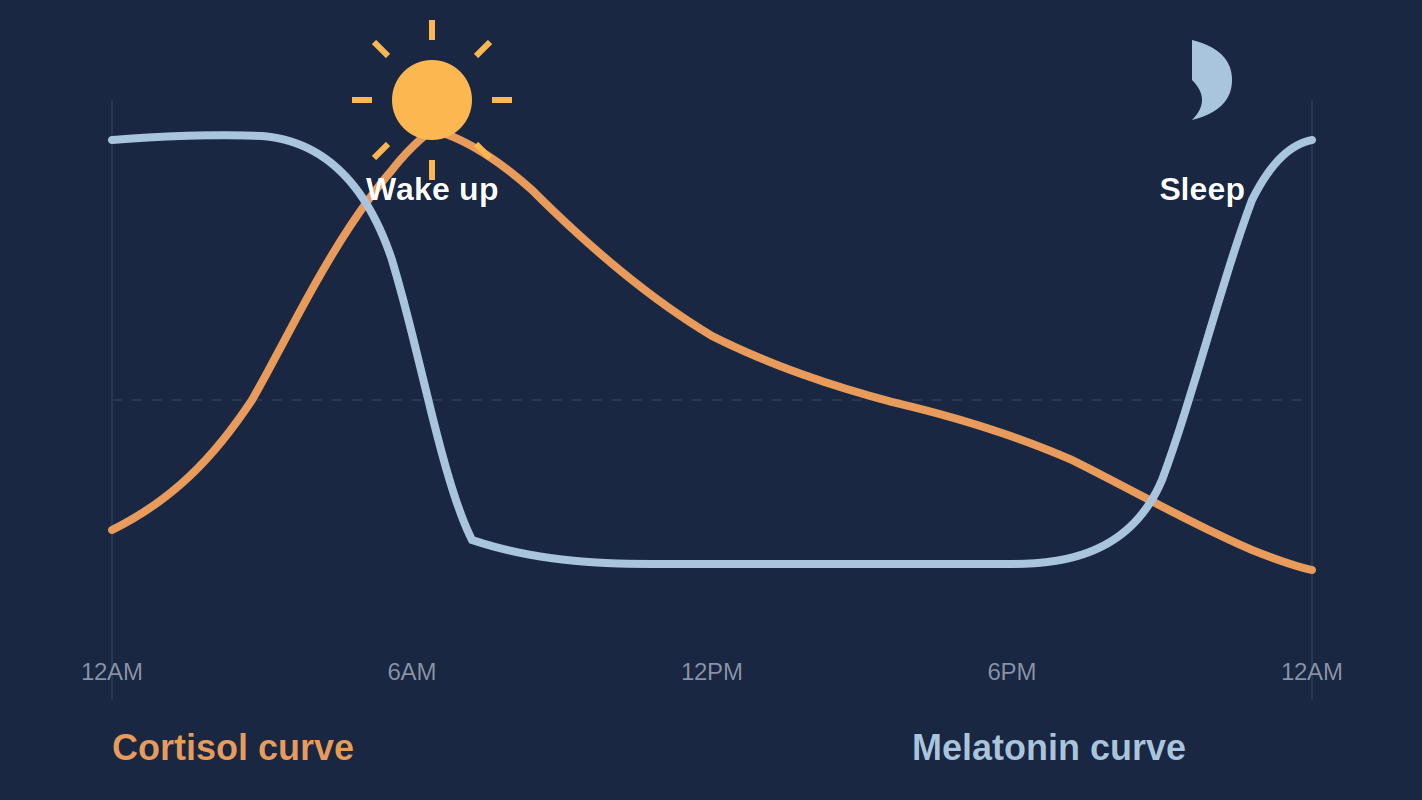
6-8 AM: Cortisol peaks. This is what wakes you up naturally, gives you energy to start the day, gets you out of bed without hitting snooze five times.
Throughout the day: Cortisol gradually declines. You maintain steady energy but you're not wired. You feel alert and functional.
Evening (8-10 PM): Cortisol drops to its lowest point. This signals your body that it's time to sleep. Melatonin rises. Your nervous system shifts into rest-and-digest mode.
Middle of the night: Cortisol stays low. You sleep deeply. Your body repairs, consolidates memories, clears metabolic waste from your brain.
Morning: Cortisol rises again. The cycle repeats.
This is the natural circadian rhythm your body evolved to follow. When it works, you fall asleep easily, sleep through the night, and wake up feeling rested.
When it's broken, you get the nightmare scenario: wired at night, dead in the morning.
What Breaks The Cortisol Rhythm
Chronic stress.
Your adrenals produce cortisol in response to stress. Any stress. Physical stress (pain, inflammation, infection). Chemical stress (blood sugar crashes, food sensitivities, toxins). Emotional stress (work, relationships, finances). Electromagnetic stress (screens, artificial light).
When stress is acute and short-term, cortisol spikes, handles the threat, and returns to baseline. The rhythm stays intact.
When stress is chronic and unrelenting, your adrenals keep producing cortisol at the wrong times. The natural rhythm gets disrupted.
Here's what happens:
Stage 1: Cortisol stays elevated at night when it should be dropping. You're tired but you can't sleep. Your mind won't shut off. You feel wired. This is your body stuck in fight-or-flight mode when it should be resting.
Stage 2: Cortisol production can't keep up anymore. Your adrenals are exhausted. Morning cortisol doesn't peak the way it should. You can't wake up. You feel like death until caffeine and adrenaline kick in hours later.
Stage 3: The rhythm is completely inverted. Cortisol is low in the morning (when it should be high) and spikes at night (when it should be low). You're exhausted all day and wired all night. This is the "wired and tired" pattern that destroys people.
This is adrenal fatigue, and if you're reading this, you probably have it.
Why You Wake Up at 2 AM
Middle-of-the-night waking is almost always a cortisol surge.
Here's the mechanism: Your blood sugar drops overnight because you're not eating. Normally, your liver releases stored glucose to keep blood sugar stable while you sleep.
But when your adrenals are fatigued, cortisol production is unreliable. Your body panics because blood sugar is dropping. It triggers an emergency cortisol release to mobilize glucose.
That cortisol surge wakes you up. Now you're lying there at 2 or 3 AM, heart racing, mind going, unable to fall back asleep.
This is why eating protein before bed helps some people. It stabilizes blood sugar overnight so your body doesn't need the emergency cortisol dump.
Why Coffee Stops Working
Caffeine doesn't give you energy. It blocks adenosine receptors, which temporarily masks fatigue. But it also triggers cortisol release.
When your adrenals are already depleted, caffeine forces them to produce cortisol they don't have reserves for. You get a temporary boost, then crash harder.
The more depleted you are, the less caffeine works. Eventually you're drinking coffee just to function at baseline, not to feel energized.
If you're at the point where you need coffee to wake up and it barely works, your adrenals are past the early stages of dysfunction.
Why "Just Relax" Doesn't Work
People with broken cortisol rhythms hear this constantly. "You need to relax." "Try meditation." "Just wind down before bed."
Those things help. But they don't fix the underlying problem.
When cortisol is elevated at night because your adrenals are responding to chronic stress, telling yourself to relax doesn't override the hormonal signal. Your body is producing a wakefulness hormone. Melatonin can't compete with that.
You need to address why your adrenals are stuck in overdrive. That means dealing with the sources of chronic stress, supporting adrenal function, and resetting the cortisol rhythm.
The Inflammation Connection
Cortisol is also your body's primary anti-inflammatory hormone.
When cortisol is low (morning exhaustion), your body can't control inflammation. You wake up stiff, achy, puffy, brain foggy. Everything hurts until your cortisol finally rises later in the day.
When cortisol is high at the wrong times (nighttime wakefulness), it's often because your body is trying to control inflammation that's spiking from food sensitivities, gut dysfunction, or chronic infection.
The science behind the adrenal gland explains this in more detail, but the short version is: cortisol doesn't just respond to stress. It responds to inflammation. And inflammation is a stressor.
If you have chronic gut issues, food sensitivities, or systemic inflammation, your cortisol rhythm will stay disrupted no matter how much you meditate.
What To Do About It
Fixing a broken cortisol rhythm takes time. Your adrenals didn't break overnight and they won't fix overnight. But here's where to start:
1. Stabilize your blood sugar.
Eat protein at every meal, especially breakfast. Don't skip meals. Don't do extended fasting if your adrenals are already depleted.
Blood sugar crashes force cortisol surges. Every crash makes the problem worse.
If you wake up at 2 or 3 AM, try eating a small protein snack before bed. Handful of nuts, hard-boiled egg, something that won't spike blood sugar but will keep it stable overnight.
2. Control light exposure.
Bright light in the morning tells your body it's time to wake up and produce cortisol. Darkness at night tells your body it's time to sleep and let cortisol drop.
Get outside in natural light within 30 minutes of waking. No sunglasses. Even on cloudy days. This helps reset your circadian rhythm.
At night, dim the lights after sunset. Blue light from screens suppresses melatonin and can trigger cortisol. Use blue blockers if you're on devices at night, or just turn everything off two hours before bed.
3. Address the stress sources.
Chronic stress isn't just emotional. It's physical pain. Food sensitivities. Blood sugar dysfunction. Gut infections. Inflammation. Toxic relationships. Jobs that destroy you. Financial instability.
You can't cortisol-supplement your way out of a life that's actively breaking you.
Identify what's causing chronic activation of your stress response and deal with it. That might mean dietary changes, fixing your gut, leaving a bad situation, or building better boundaries.
For comprehensive guidance on managing all three types of stress (chemical, structural, emotional), visit the Regulate Your System resource page.
4. Support your adrenals strategically.
Adaptogenic herbs (ashwagandha, rhodiola, holy basil) can help modulate cortisol. Phosphatidylserine can lower nighttime cortisol. B vitamins and vitamin C are cofactors for cortisol production.
But supplementation without addressing root causes is just band-aids.
If you're already taking adrenal support and it's not working, you're either taking the wrong thing for your pattern, or there's an underlying driver (gut dysfunction, food sensitivities, chronic infection) that needs to be addressed first.
For nutritional strategies that support adrenal function, visit the Fuel Your Body resource page.
5. Test your cortisol rhythm, don't guess.
A single morning cortisol test tells you almost nothing. Cortisol changes throughout the day. You need to test the rhythm.
The best test is a 4-point salivary cortisol panel: morning, noon, evening, night. This shows you the actual curve and identifies where it's broken.
From there you can build a targeted protocol instead of guessing.
The Timeline
If your cortisol rhythm is moderately disrupted, you can start seeing improvement in 4-6 weeks with proper support.
If it's severely disrupted (completely inverted rhythm, Stage 3 adrenal dysfunction), it can take 6-12 months to fully restore.
This isn't a quick fix. But it's fixable.
The longer you ignore it, the worse it gets. Eventually you end up so depleted you can't function without pharmaceutical intervention.
Most people wait until they're completely broken before they address it. Don't be most people.
You're Not Broken, Your Rhythm Is
If you're reading this at 2 AM because you can't sleep, or you're reading it at 10 AM because you still can't wake up, you're not broken.
Your body is doing exactly what it's designed to do when faced with chronic stress. Your adrenals are producing cortisol in response to threats—real or perceived, physical or emotional.
The problem isn't you. The problem is the rhythm got disrupted and now needs to be reset.
That's fixable.
But it requires understanding what's actually broken, testing properly, and addressing root causes instead of just treating symptoms.
If you're dealing with sleep problems, chronic fatigue, or suspected cortisol dysfunction and you're in the Frisco, Texas area, our practice specializes in comprehensive adrenal testing including 4-point cortisol rhythm panels. We use Applied Kinesiology to identify underlying stressors and build targeted protocols. Schedule an appointment to test your cortisol rhythm and fix what's broken.
Stay connected with news and updates!
Join our mailing list to receive the latest news and updates from our team.
Don't worry, your information will not be shared.